February 2, 2012

1911 - adding bone casings


There are 75 of us over at the flickr group! A great team of eyes to help you sew and fit your corset as the sew along progresses. If you haven't joined it's not too late!

Today we will add the bone casings. Sewing separate bone casings is not difficult at all, and once you know how to do it you can add extra casings to any corset with no problem. Place the pattern piece on the corresponding panel of the corset and mark the center of the casing at the top and bottom edges.


Pin the casing in place at the top of the corset.


Then pull the corset so it lies flat and continue pinning the casing in place from the top down. The casing will always be in straight line once the fabric is pulled taut even if it curves on the pattern. My casings are still strips of bias coutil, I just covered them with colored bias tape so they would be fancy.


On casings that hold two bones sew right down the center from top to bottom. Then sew 1/16 from each edge. If you make it a generous 1/16 inch that's OK. Use a longer stitch length than was used to sew the body of the corset. It makes it much easier to sew.


On the casing that hold the single 1/2 wide bone sew 1/8 inch from each edge.


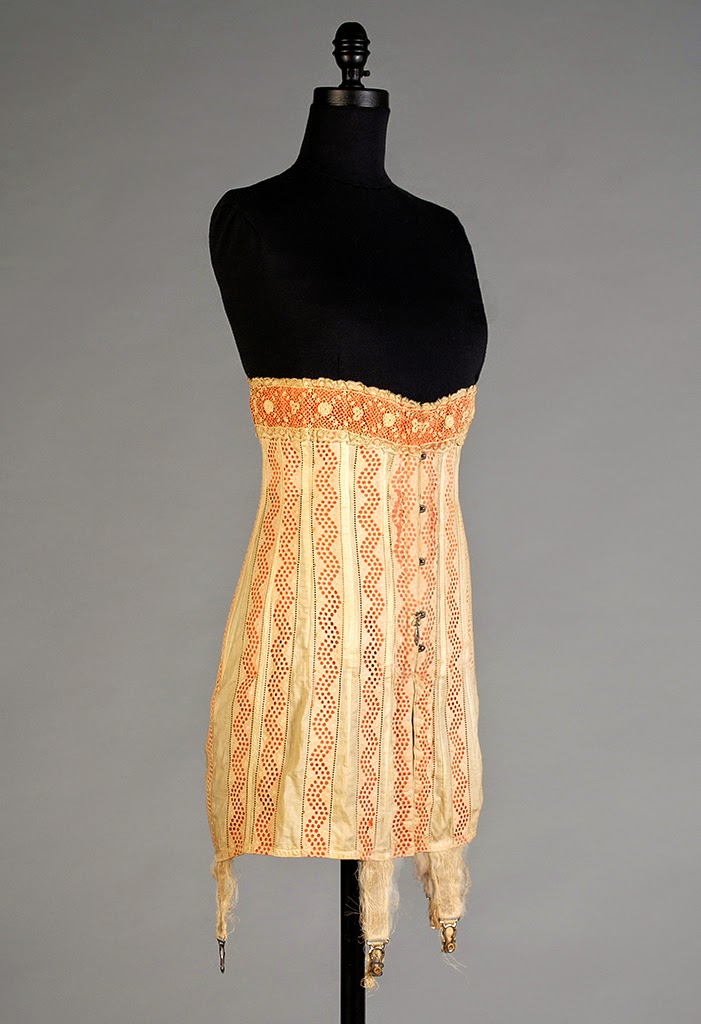
The stitches will show from the front so take your time and sew steadily. Here is one of my finished casings so you can compare it to the one on the post Edwardian corset I showed you yesterday.


If you are new to corset making sew the back channels first and the front ones last. That way your neatest casing will be at the front of the corset and any wobbly lines will be more hidden.

February 1, 2012

1911 - making bias tape and bone casings


The bones in the corset need to be housed in something, so, bone casing. If you haven't purchased pre-made bone casings you can make your own. I construct casing based on the construction of the post Edwardian corset use to make the pattern for the Foundations Revealed article. Here is a detail of the corset backlit so you can see how the casing was built.


It is just a strip of fabric with the edges folded under. I make casings using bias strips of coutil because I've found the bias makes the casings lie smoother against the curves of the body, but you can cut them on the grain too. Either way will work. If you will be making casings you'll need coutil, a ruler, a pencil, scissors, and an iron. Start by drawing a line 45 degrees to the grain of the fabric.


If you don't have a triangle you can measure from a corner along the selvedge, mark the same distance on the cross grain, then connect the points. Cut strips of fabric 1 7/8 inch wide. The casing needs to run the length of the corset so make sure the strips are long enough. If you have a 25mm bias tape folder you can pull the fabric through.


If not just fold the edges so they barely meet in the middle and press.


That's it! If you need bias trim to finish the top and bottom edges you'll make it the exact same way. Tomorrow we'll stitch the casings to the corset and Friday we'll attach the back facing.

January 31, 2012

1911 - waist tape


There are a lot of things you must do when making a corset, but for the sew along a waist tape isn't one of them. It's up to you. A non-stretch twill tape can be secured to the inside of the corset to prevent the waist from stretching, some corsets have this, some do not. Norah Waugh's Corsets and Crinolines pattern indicates a waist tape, the post Edwardian corset I used to draft the pattern for the Foundations Revealed article did not have a waist tape. If you decide to add one you'll need the twill tape or grosgrain ribbon, pins, and the pattern.

Lay the tape on the interior of the corset across the waist. The center back will have the two notch marks, the top one is the waistline, and you can find the center front by placing the pattern piece on the corset. As you lay the tape down pull the fabric of the corset taut, pin the tape, then pull the next section taut.


Don't be surprised if when you are done and no longer holding the fabric under tension the tape is loose next to the fabric.


When the corset is worn the fabric will be pulled tight against the body and the tape will lie flush with the corset. When the bone casings are sewn in place the stitching will hold the waist stay too. Yea, two jobs with one stitch!

January 30, 2012

1911 - the last work on the pattern, really.


Welcome to week 5 of the corset sew along! Did I say our patterns were finished? Whoops. But after this last little bit of work they really will be. We need to mark the boning placement since the patterns were slashed and spread, or slashed and shrunk. All you'll need today is the pattern, a pencil, a straight edge and hip curve. You may want a highlighter too.

If the boning runs along the seam, as it does on most pieces if the post Edwardian pattern, you don't need to change a thing. But others not on the seams will shift a bit. Find the center between the boning when the pattern has been spread.


Using the hip curve extend the line to the top and bottom edges of the corset, blending to make a smooth transition.


Sometimes all that needs to be done is extend the lines with a straight edge.


I drew the casings in and highlighted them, but the center line is really all that is necessary since the casing will be centered on this line. Here is the competed pattern.


Later this week we will sew the bone casing and attach the back facing. How is the corset construction progressing?

January 29, 2012

corset nerves


Sewing the real corset is always different than sewing the mock-up.


Even though I've pretty much gone through all the steps needed to make the corset, when I sit down at the machine to begin constructing the finished piece I tense up. Knowing it counts makes it more difficult. If you are sewing along with me don't fall victim to corset nerves! They will make you not only nervous, but hyper critical and prevent you from moving forward. Just keep stitching.